Events
International events of 2016: quantum chaos and physics education
Two international meetings in July 2016 were relevant to the optics community in Chile: a winter school for young researchers in quantum physics and a world conference for physics educators.
Giambiagi Winter School: Quantum Chaos & Control
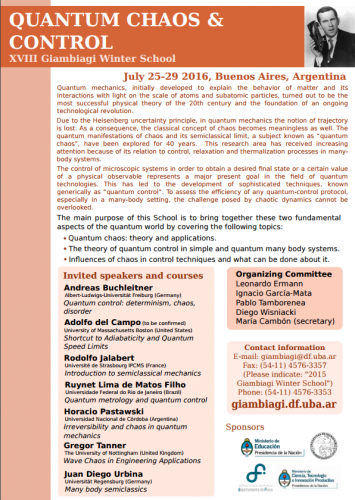
Date: 25 to 29 July 2016 Place: Buenos Aires, Argentina
The Giambiagi Winter School was organised by the School of Exact and Natural Sciences of the University of Buenos Aires. Its main purpose was to give graduate students and young researchers an up-to-date view of a field, presented by world-recognised experts. The 2016 edition was devoted to Quantum Chaos & Control and ran from 25 to 29 July.
Why optics is a natural laboratory for quantum chaos
Quantum chaos asks how the unpredictability of classical chaotic motion shows up in systems governed by quantum mechanics, where particles do not follow sharp trajectories. Optics offers some of the cleanest places to look. A light wave trapped in a cavity with an irregular shape, such as a stadium-shaped mirror arrangement or a slightly deformed glass microdisk, behaves much like a quantum particle bouncing inside a box. Its allowed modes, the spacing between their frequencies and the patterns they form can be measured directly with cameras and detectors, which is far easier than probing the energy levels of a heavy nucleus.
Control is the other half of the school’s title. Quantum control means steering a quantum system into a chosen state, using carefully shaped laser pulses or electromagnetic fields. It underlies precise atomic clocks and every attempt to build a quantum computer, since a qubit is only useful if it can be driven reliably from one state to another. Chaos makes that harder, because small errors in a chaotic system grow quickly, and understanding that growth is part of designing robust control.
For a graduate student, a week-long school on such a topic is a compressed course: several lecturers cover the foundations in a few sessions each, and the poster sessions let students test their own results against people who know the field well. The centre’s work on photons and quantum information is described under quantum information.
World Conference on Physics Education
Date: 10 to 15 July 2016 Place: São Paulo, Brazil
The second World Conference on Physics Education was held in São Paulo and was aimed at physics educators, teachers, researchers and policy makers from around the world. The conference series was initiated by the Groupe International de Recherche sur l’Enseignement de la Physique (GIREP) and the International Commission on Physics Education (ICPE), Commission 14 of the International Union for Pure and Applied Physics (IUPAP). It was sponsored by GIREP, ICPE and the Multimedia in Physics Teaching and Learning (MPTL) group, and endorsed by the American Association of Physics Teachers (AAPT), the Latin American Physics Education Network (LAPEN) and the Asian Physics Education Network (AsPEN).
The organisers wanted a global, participative process before, during and after the conference, structured to foster collaboration in physics education research and development across national borders. Working sessions were to produce action plans to strengthen the teaching and learning of physics at all levels and in many countries. The conference was conceived as the start of a series held every four years, a working conference whose follow-up actions would carry over to the next edition.
Physics education as a research field
Physics education research studies how people learn physics and how teaching can be improved, with the same habits of evidence as any other branch of science. Researchers design tests of conceptual understanding, compare teaching methods across classrooms and follow how students’ ideas change over a course. A recurring finding is that many intuitive ideas about motion, heat or light survive traditional lectures almost untouched, and that lessons in which students predict an outcome, observe it and then discuss the difference tend to change those ideas more effectively.
That is why a conference series built around shared action plans makes sense. Curricula, teacher training and examination systems differ from country to country, and comparing them is often the quickest way for a school system to see its own blind spots.
Events in Chile, such as the centre’s summer schools and workshops, are listed under outreach.